Last updated November 22, 2026
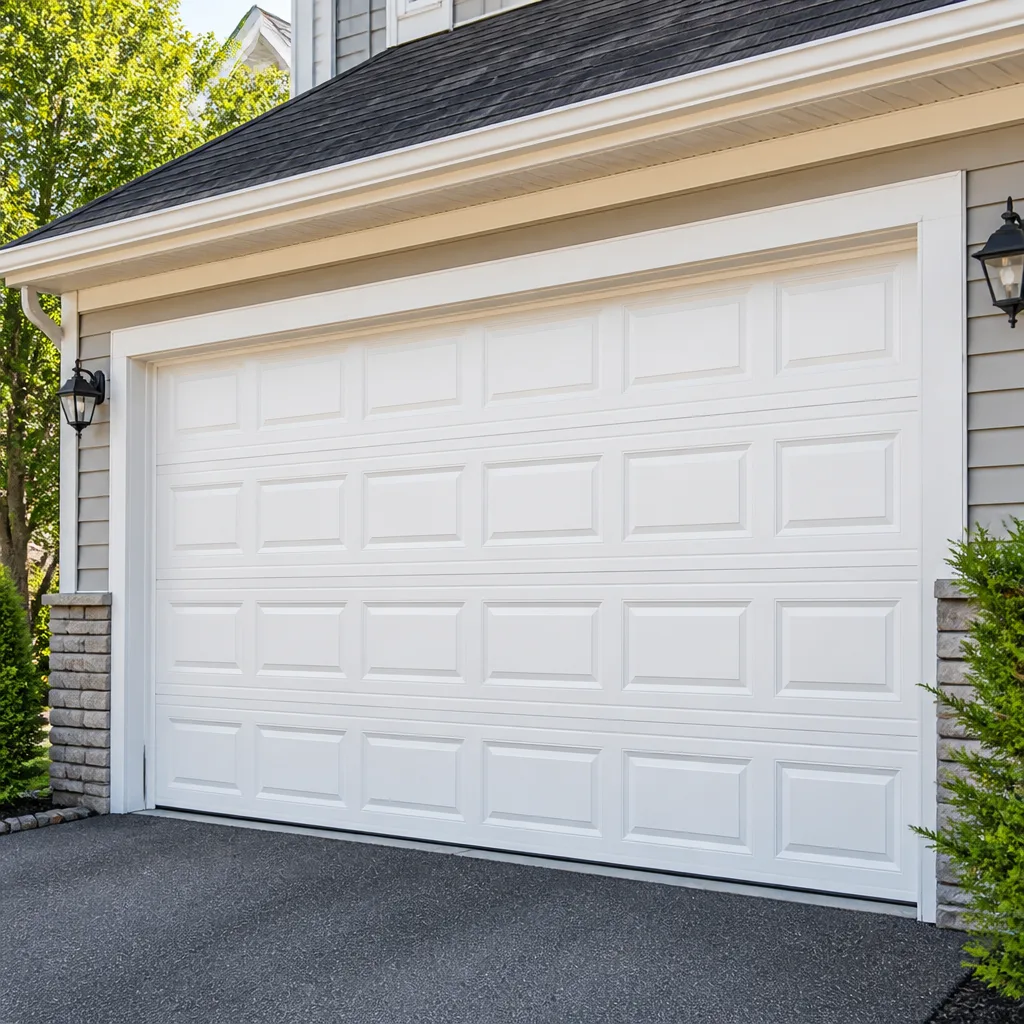 Raised-panel steel
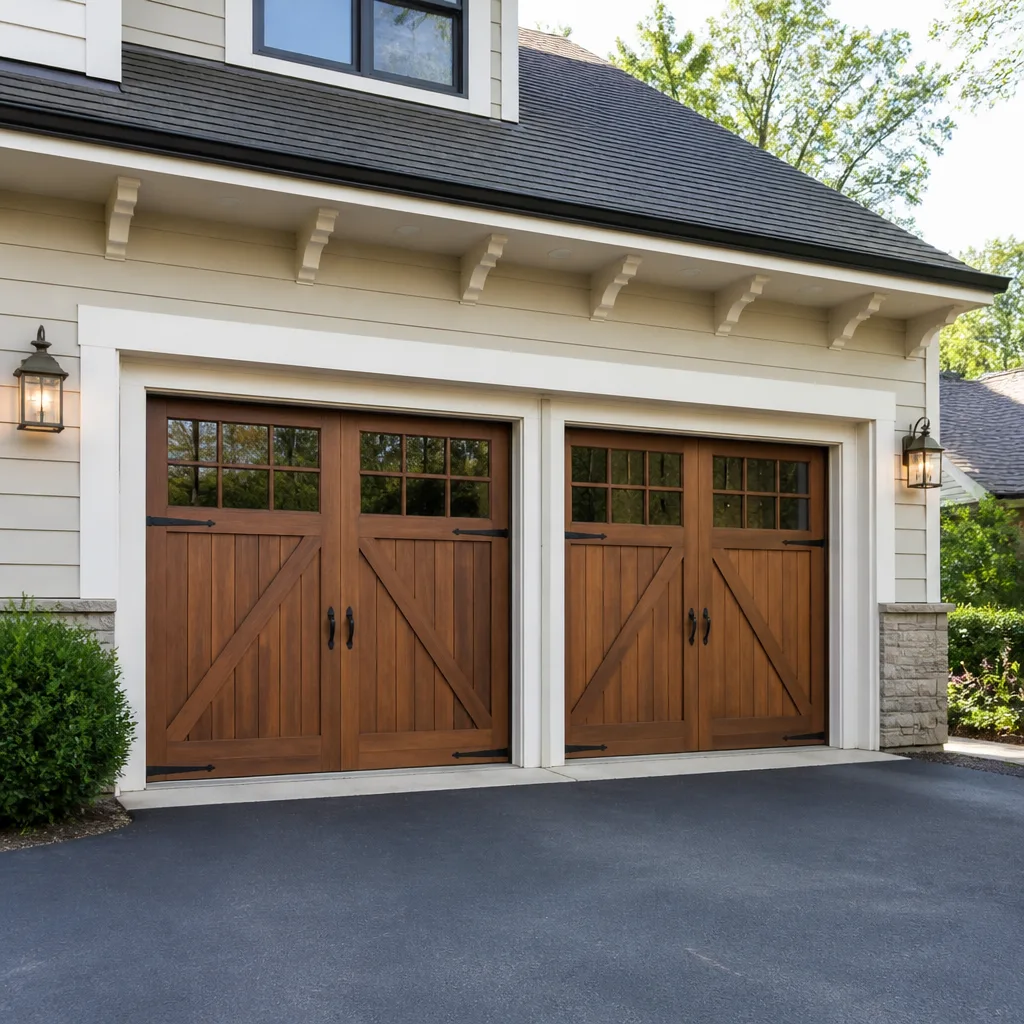 Carriage house
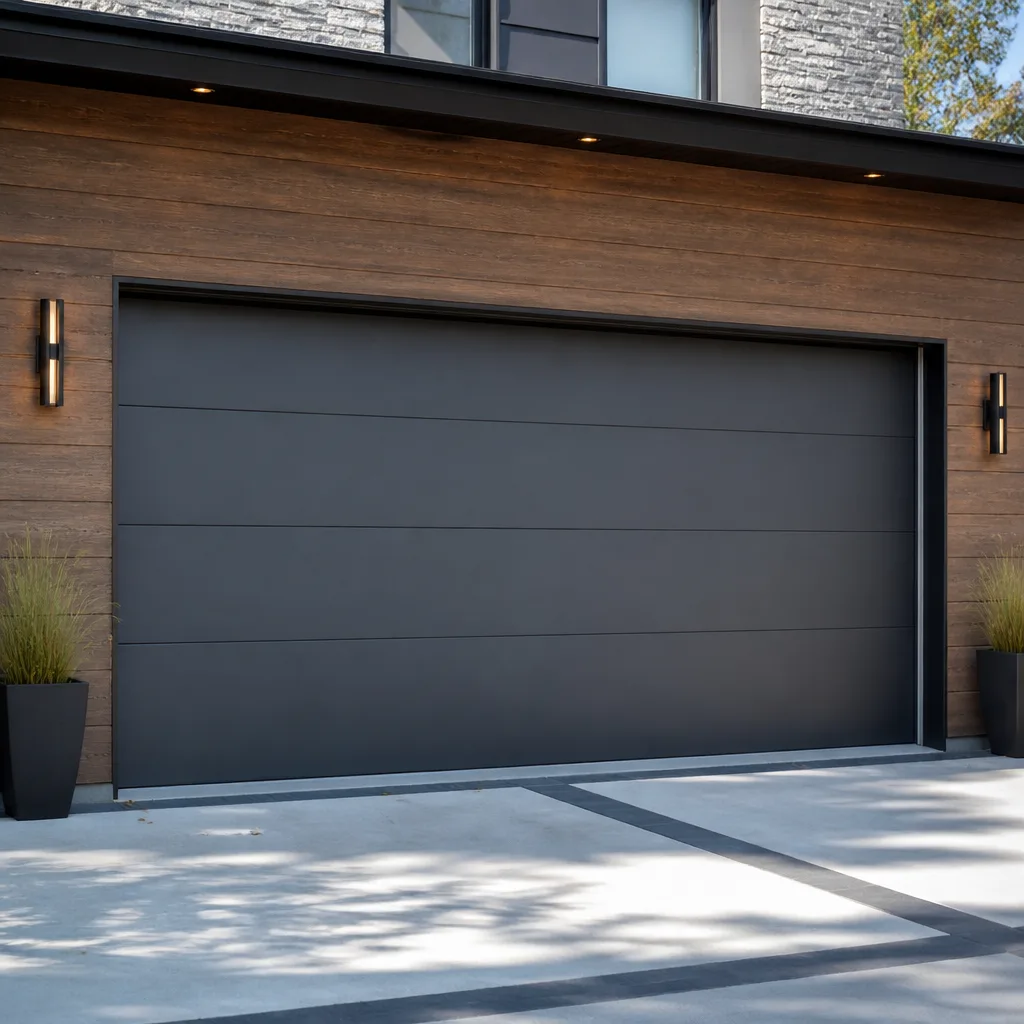 Modern flush
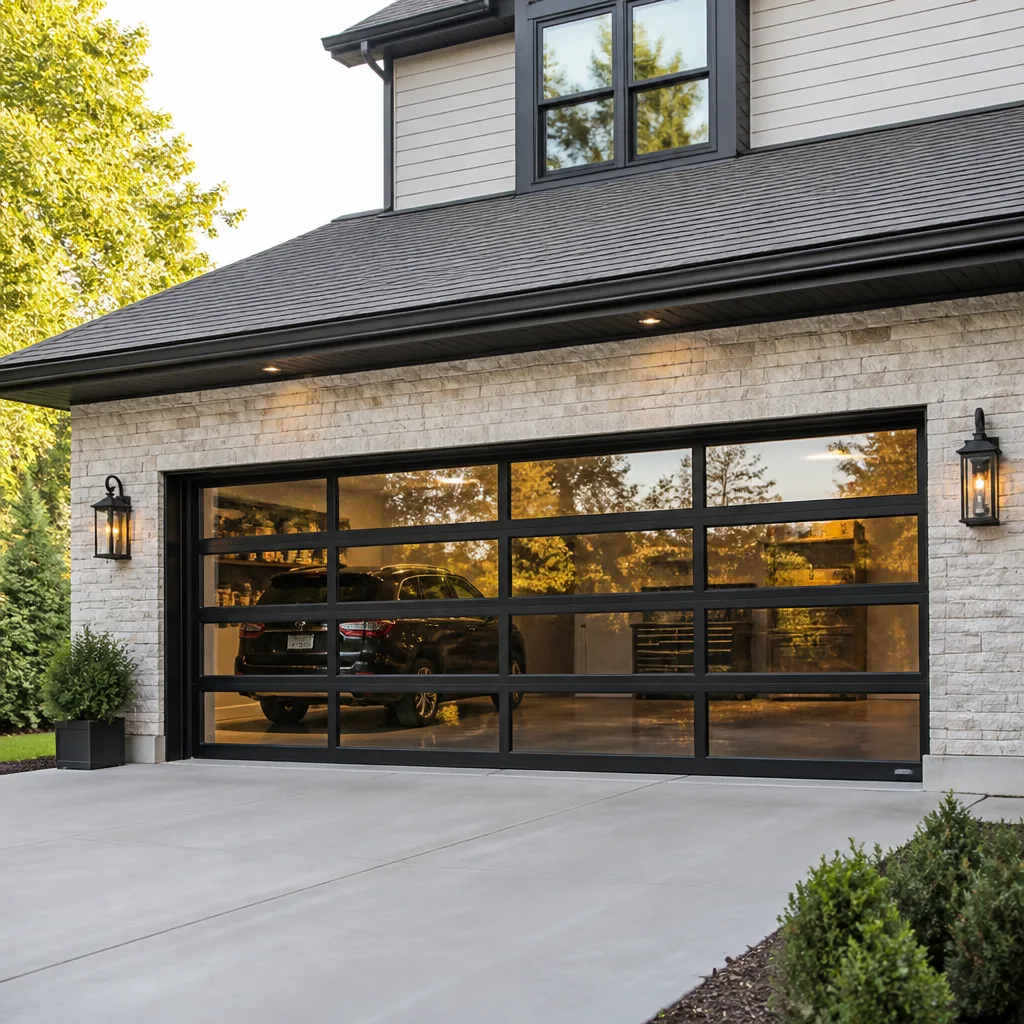 Full-view glass
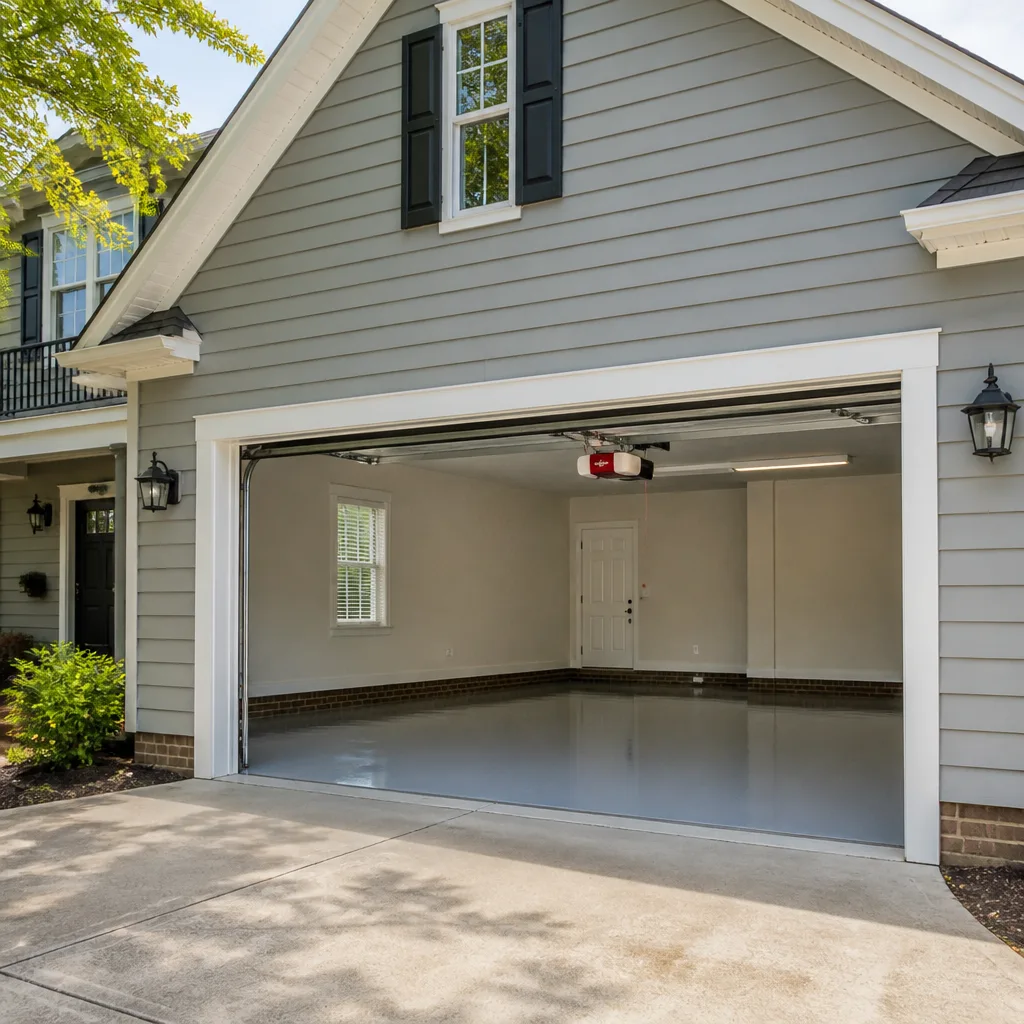 LiftMaster openers
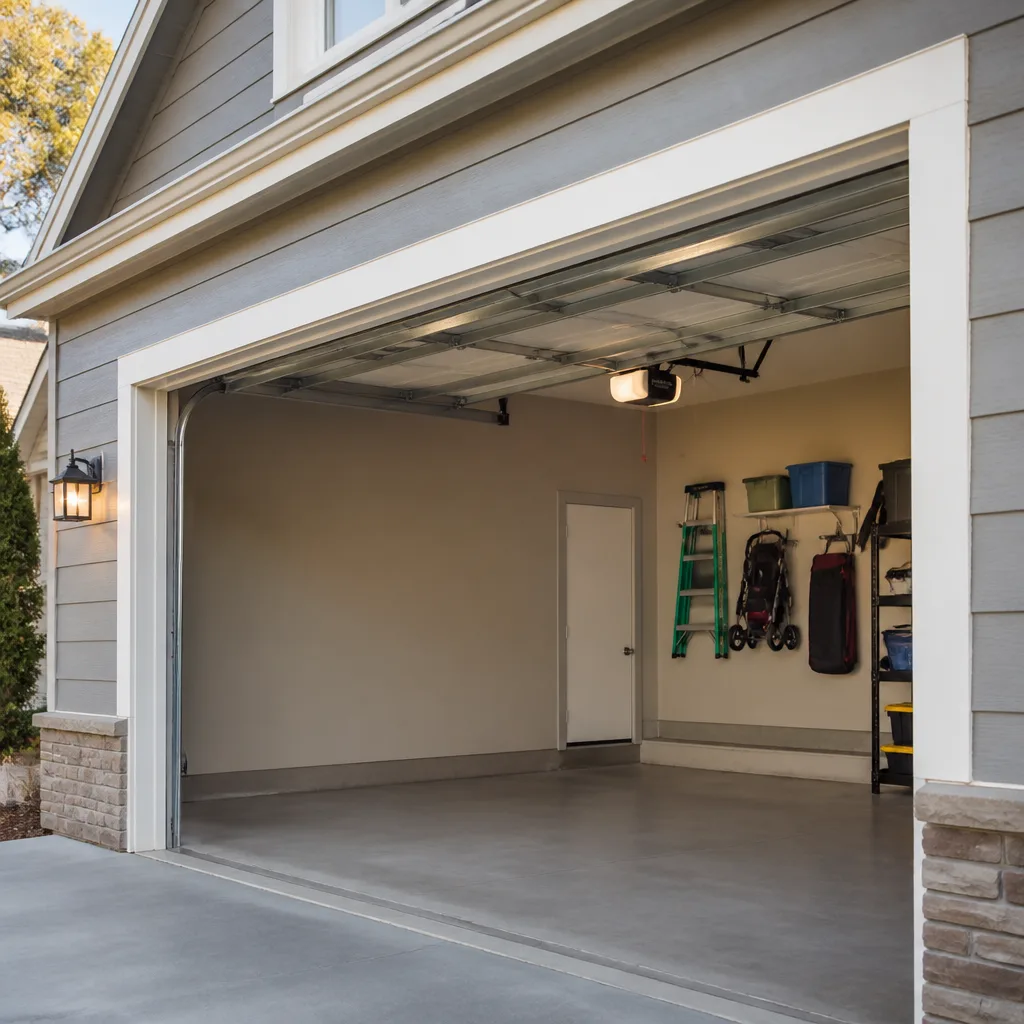 Chamberlain openers
Full 25-point door and opener safety check with every visit - springs, cables, rollers, tracks, and your LiftMaster or Chamberlain opener included
You get a price before we start. It does not change when the pro arrives.
Get your free estimateGarage Door Repair Maintenance Checklist for Plantation Homeowners
The garage door is a security system, an electrical system, and a mechanical system all stacked in the same opening, which is exactly why the failures that matter here tend to stay hidden until they’re urgent. A door passes a visual glance in August and fails without warning in September because the problem was never something you could see from the driveway – it was a torsion spring anchor backing out of the wall, a bottom seal gone soft, or an opener logic board quietly cooking every time afternoon storms roll through. What follows is a maintenance plan built around how doors actually fail in Plantation, organized by the season you should be checking each part.
Quick Answer
Garage door maintenance in Plantation comes down to four habits: lubricate the torsion springs, hinges, and rollers twice a year with a silicone or lithium grease (never WD-40); check the bottom seal for compression loss every few months since oversized threshold gaps let water and pests in; verify the spring anchor plate is flush against the wall; and test the safety reverse monthly. Pair those checks with a whole-home surge protector for a wall-mounted opener, and you’ll catch most wear before it becomes a same-day emergency.
Styles & brands we work with
- Raised-panel steel
- Carriage house
- Modern flush
- Full-view glass
- LiftMaster openers
- Chamberlain openers
Table of Contents
- Month-by-Month Maintenance for Plantation’s Seasonal Pattern
- Lubrication That Survives Humid Plantation Summers
- Checking the Bottom Seal Against Older Florida Threshold Gaps
- The Spring Anchor Plate: What Three Hurricane Seasons Reveal
- Monthly Safety Reverse and Balance Tests
- Surge Protection for Openers (The Step Everyone Skips)
- The Five-Minute Spring Tension Test You Can Do Safely
Month-by-Month Maintenance for Plantation’s Seasonal Pattern
Most garage door maintenance guides are written for four-season climates, which produces a schedule that never quite lines up with how doors behave in Plantation. Here the door never sits under snow load and stops working because of frost. Instead, the seasonal threats are spring humidity spikes, months of afternoon thunderstorms producing line surges, and hurricane-season wind that loads every hinge and bracket. Winter, for its part, is mild and stable. Maintenance should follow that rhythm.
- January through February: Deep-clean the tracks and lubricate moving parts after the cooler dry stretch when dust accumulates. Check the weatherstripping on the sides and top while you’re there.
- March through April: The spring pre-season check. Look at the anchor plate, watch the door’s balance, and listen for grinding. This is the point to schedule a professional once-over before the heavy wind months begin.
- May: Before hurricane season, verify that the door’s wind rating hardware (if your door was installed with one) is intact and that the opener can open the door without assistance. Clear the garage of anything stored within a foot of the track.
- June through September: Monthly safety reverse tests. Watch for anything that loosened during storm cycles – screws in the hinges, the lift cable wraps, and the bolts on the torsion shaft.
- October through November: The end-of-season inspection. Test the door’s balance, look at the bottom seal, and have a technician assess any hum, rattle, or slow response that appeared during summer.
- December: Lubrication round two. Wipe down the tracks and re-grease rollers, hinges, and the torsion spring coil.
If a specific month is missed, don’t try to compress the work. Late checks accumulate. Catching a corroded roller in October is a small job; discovering it after it has eaten into the track is a bigger one.
Lubrication That Survives Humid Plantation Summers
The right lubricant for Plantation is one that clings to metal, resists emulsifying with water, and doesn’t collect grit. That rules out several products that work fine in dry climates. In our own service experience across every major opener and door brand, the wrong lubricant is nearly as common a cause of premature wear as no lubricant at all.
What works:
- Silicone-based spray lubricant. It goes on dry, doesn’t hold dust, and doesn’t grab every gram of pollen blowing through Plantation in spring.
- White lithium grease. It goes on thick and stays put on the hinge pins and torsion tube. Best for parts subjected to heavy load.
- Specific products designed for torsion springs. A small amount on the spring coil is enough. Use it sparingly.
What doesn’t work, or works against you:
- WD-40 in the traditional blue can. It’s a solvent, not a lubricant. It cleans surfaces well but leaves nothing behind to protect the metal. Applied repeatedly it can actually dry out existing grease deposits.
- Motor oil or generic spray oils. They’re the wrong viscosity, they run off, and they trap grit that accelerates roller wear.
- Heavy grease on nylon rollers. Nylon rollers are meant to run dry (or with a light silicone film). Grease attracts grit that grinds the roller against the shaft.
- Skipping the tracks. Many people forget to wipe the tracks, but a can of compressed air and a clean dry rag removes sand and leaf debris that has no business being there.
Do all moving parts at least twice a year. In Plantation’s humidity, the schedule that matters more: check frequently enough that you notice when a lubricated surface starts to feel sticky. That stickiness is the first sign that a product has begun to attract grit rather than repel it.
Checking the Bottom Seal Against Older Florida Threshold Gaps
The bottom seal is the piece of rubber that touches concrete and shields the garage interior from rain, insects, small animals, exhaust, and heat. Older Plantation ranch homes were frequently built with oversized threshold gaps – concrete settling unevenly, a slope from the driveway, or a long garage opening – and a standard bottom seal will compress unevenly across that span. That’s why the check isn’t just “does it look worn” but “does it actually seal.”
The five-minute check:
- Shine a flashlight under the closed door from inside the garage. Any light coming through means a gap. Do it at multiple points across the width.
- Press a piece of paper under the seal and pull it out slowly. If the paper slides out with no resistance, the seal isn’t compressing there. A firm drag is what you want.
- Run a hand along the underside of the seal from corner to corner. You’re checking for flat spots, soft or chewed sections, and splits at the edges.
- Look at the corners. Corners are where water enters first on doors with old thresholds. If the seal has pulled away from the retainer, that’s a sign the whole piece is failing.
If you find a consistent gap in the middle or a low corner, that’s a threshold problem, not just a seal problem. Sometimes a thicker or adjustable bottom seal solves it. Sometimes the concrete needs a threshold strip. That’s a conversation worth having before the rainy season rather than during it. Replacement seals and the retainer hardware are inexpensive; the water damage they prevent isn’t.
The Spring Anchor Plate: What Three Hurricane Seasons Reveal
Torsion springs attach to a metal plate bolted to the wall above the door. The plate has to stay perfectly flush against that wall. When it doesn’t – when the bolts work loose or the wood behind them softens from water intrusion – the entire load of the springs transfers to a point that wasn’t designed to hold it. In our service experience, the first sign isn’t a noise. It’s a door that opens with uneven effort from one side or lifts with more force than it used to. The driver may report it as “the door feels heavier.”
What to look at, without touching hardware:
- Look up. From the garage floor, sight along the wall where the anchor plate is bolted. Any visible gap between the plate and the wall is a warning sign.
- Look for rust staining. Brown streaks running down from the plate or the bolts suggest moisture has been wicking into the wood behind it. That’s Plantation’s humidity and driving rain doing what it does.
- Check for bolt movement. A telltale around a bolt head – a fresh crack in the paint, a gap in a washer, a loosened nut – is more than cosmetic. Stop using the door and call for an inspection.
- Listen. A door that squeals or pops at the very start and end of travel is heavily loaded at those points. That’s worth a professional look.
Anchor plate issues are not a DIY project. The spring system holds enormous stored energy even when the door is closed, and any correction to the plate requires the springs to be relieved first. A trained technician knows that. General handymen usually don’t. Springs are among the most dangerous components in a residential garage, and the repair belongs to someone who does it every week rather than once.
Monthly Safety Reverse and Balance Tests
The garage door is the largest moving object in most homes. If its safety reverse fails, it becomes dangerous. Two tests catch nearly every failure. Both are free and both take less than two minutes.
The safety reverse test.
- Stand clear of the door. Close it fully.
- Place a firm object – a roll of paper towels or a 2×4 laid flat – in the middle of the door’s travel path on the floor.
- Press the button to close the door. When the door contacts the object, it should reverse upward immediately.
- Turn the door back down. Then test the photo-eye sensors: stand in the doorway, wave a hand or a stick through the beam as the door closes. The door should reverse.
If either test fails, do not continue to use the door. Call for garage door opener repair. A door that fails to reverse is a genuine injury risk, particularly in a household with children or pets.
The balance test.
- Disconnect the opener using the emergency release cord (usually the red handle).
- Raise the door by hand about three or four feet and let go. A balanced door holds its position or drifts very slowly.
- A door that slams shut or runs upward on its own points to a spring, cable, or track problem.
- Reconnect the door. If it fails the balance test, don’t keep running the opener against the resistance.
Run both tests once a month. In Plantation, the seasonal changes in temperature and humidity can affect the door’s balance enough that a door that passed in February may not pass in August.
Surge Protection for Openers (The Step Everyone Skips)
Most maintenance checklists stop at the door and never mention the opener’s electronics. Yet in a place with as much lightning activity as South Florida, the opener’s circuit board is one of the most surge-exposed things in the home. It’s connected to mains power in the garage, often on the same circuit as other electronics, and it operates continuously in a small enclosure that can get warm and humid.
What protects an opener:
- A dedicated surge protector plugged between the opener and its outlet. This is the single most effective step and the easiest one to add. It absorbs spike energy before it reaches the opener’s board. Look for a protector with an indicator light that tells you the protection is still active.
- A whole-home surge suppressor installed at the electrical panel. This protects everything on the circuit, including the opener. It requires an electrician, and it’s a reasonable investment for a home with a wall-mounted opener.
- Outdoor-rated protectors for openers in detached garages. If the opener lives somewhere exposed to the elements, an outdoor enclosure combined with a protector is the practical setup.
Signs an opener board has taken a hit: the wall button works but the remote doesn’t, the opener behaves erratically, the lights flash in an unfamiliar pattern, or the door stops midway. When that happens, the opener usually needs diagnostic work rather than a full replacement. Technicians who know the LiftMaster, Chamberlain, Genie, and Craftsman ecosystems can often determine whether the board is salvageable before recommending anything new.
If your opener is connected to a smart-home system through MyQ, Aladdin, or similar apps, surge protection matters twice over. The Wi-Fi chipset on a connected opener is fragile, and replacing a board to restore app function is expensive.
The Five-Minute Spring Tension Test You Can Do Safely
You can assess spring condition without touching the spring, the cable, or the torsion bar. This test uses only the door, the opener, and your ears. It’s the test a technician would run first, and it’s safe for any homeowner.
- Disconnect the opener using the emergency release.
- Lift the door to roughly waist height. Note how much effort it takes. A healthy door takes noticeable but modest effort.
- Release. The door should stay roughly where you leave it. If it drops quickly, the springs are losing lift. If it climbs, the spring tension may be too high.
- Lower the door slowly to the floor and reconnect the opener.
- Run the door once and listen. A healthy door is quiet at the spring coil. Popping, snapping, or thudding sounds at the spring indicate a problem.
What you should not do: any adjustment to the torsion spring or cable. Those are the components in the garage door system with the highest stored energy. Attempting a DIY adjustment is the leading cause of serious garage door injuries. If the five-minute test reveals a problem, that’s the point to call a trained technician rather than pick up a pair of winding bars. For an exact quote on a spring inspection, call (866) 937-8852. Estimates are free.
Common Mistakes to Avoid
- Using WD-40 as a lubricant. It’s a solvent that removes grease. Applied to rollers or a torsion spring, it strips protection and accelerates wear. Use silicone or white lithium grease instead.
- Skipping the bottom seal because it looks fine. Old Plantation ranch homes often have oversized threshold gaps, and the seal can compress fine at the corners but leave a real gap in the middle. Run the flashlight test, don’t eyeball it.
- Watching the door and ignoring the wall. The spring anchor plate is behind and above the door. Check for rust stains on the wall, plate gaps, or loosened bolts – not just the door’s movement.
- Opening and closing a failing door repeatedly to “see if it’s consistent.” If a spring or anchor plate has failed, every cycle stresses the remaining hardware. Stop, and call.
- Replacing the opener when the board just needs a surge protector. In high-lightning areas, opener boards take hits that look like opener failure. A diagnostic check separates the two before you spend money on hardware you don’t need.
- Not testing safety reverse monthly. The photo-eye and reverse test are the two most important safety checks you can run. Skipping them, especially once summer begins, leaves an injury risk unaddressed.
- Letting a general handyman do spring work. Springs are high-tension hardware. Proper repair calls for someone who handles them routinely – not the same person who fixes the fence.
See the difference
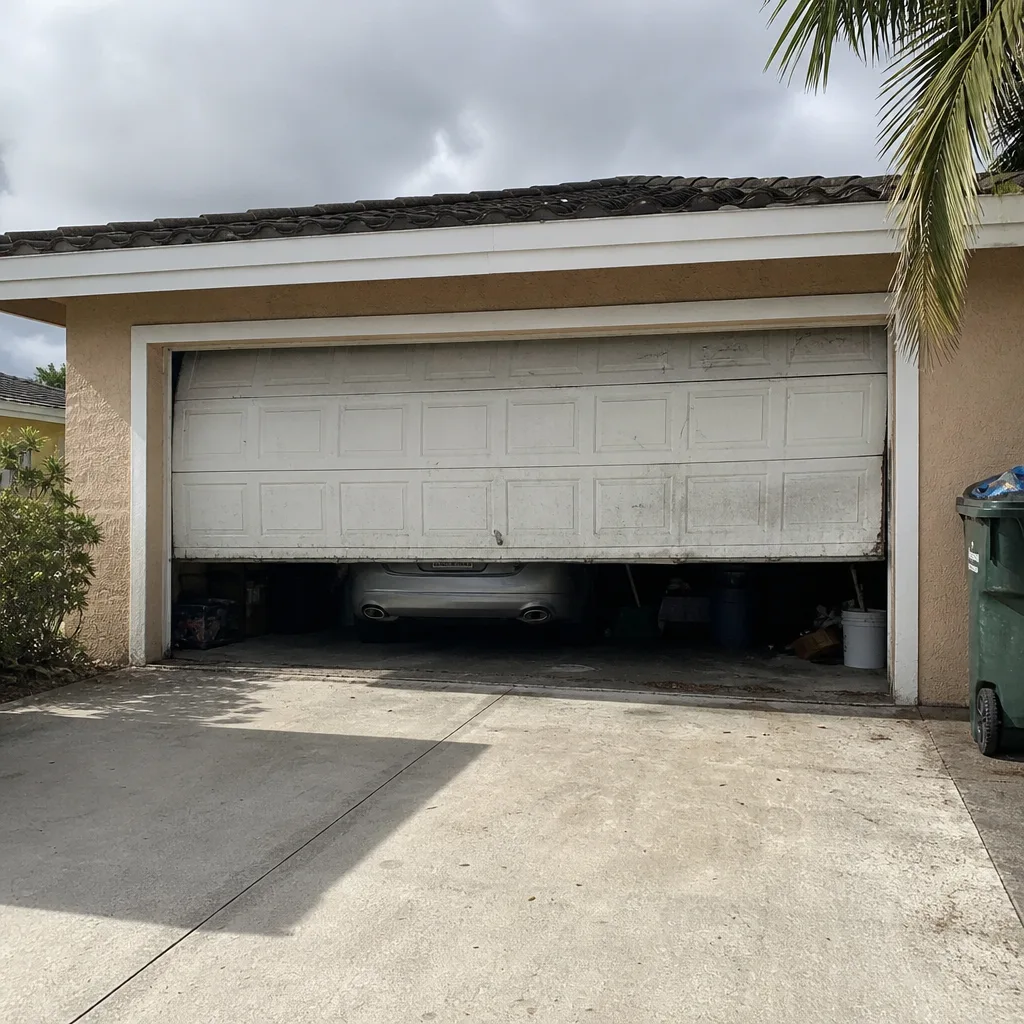 Before
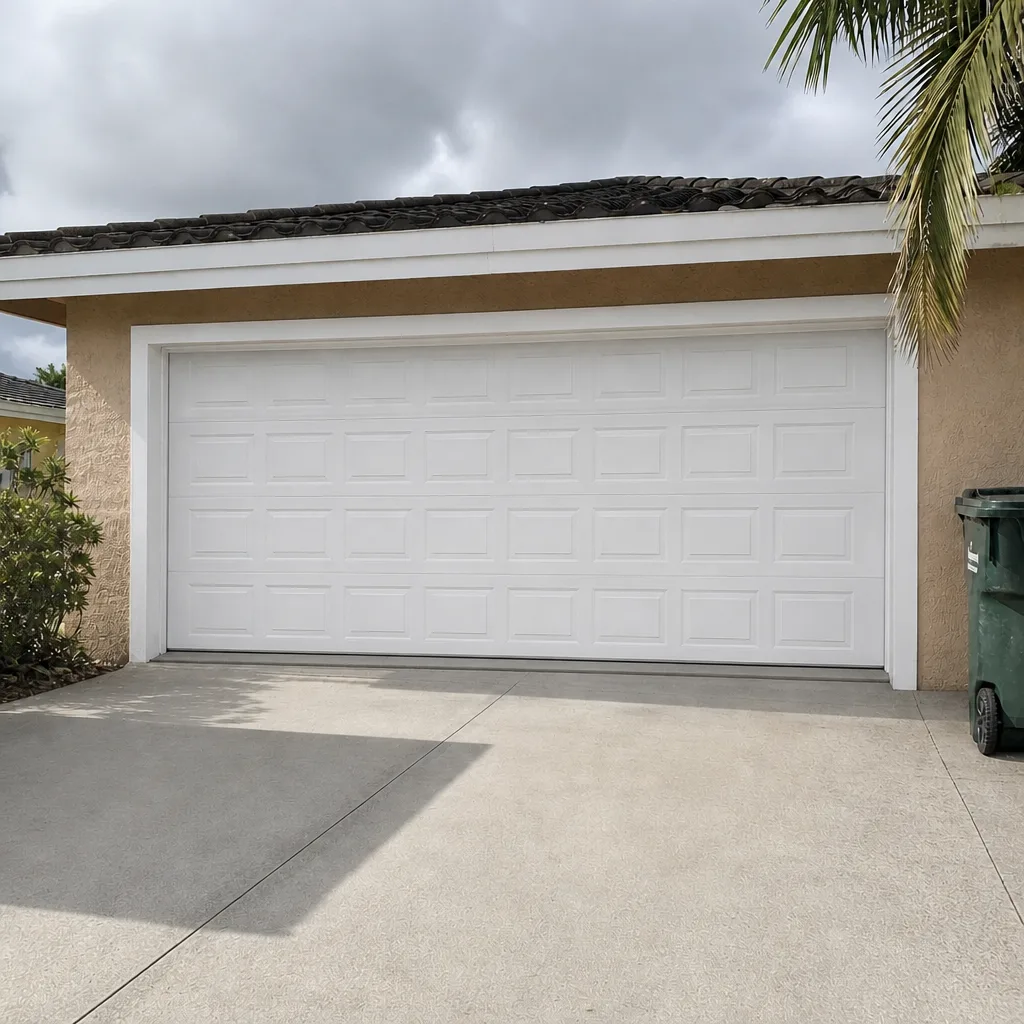 After
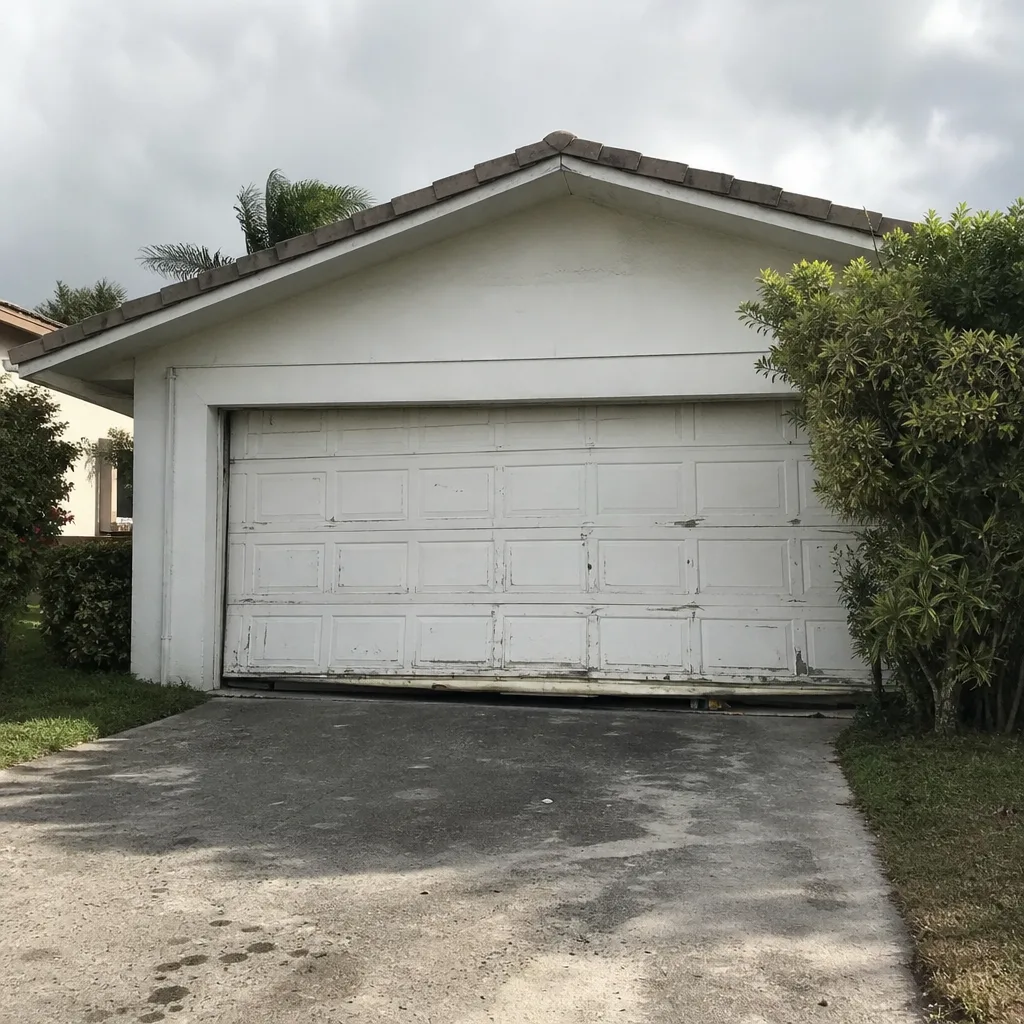 Before
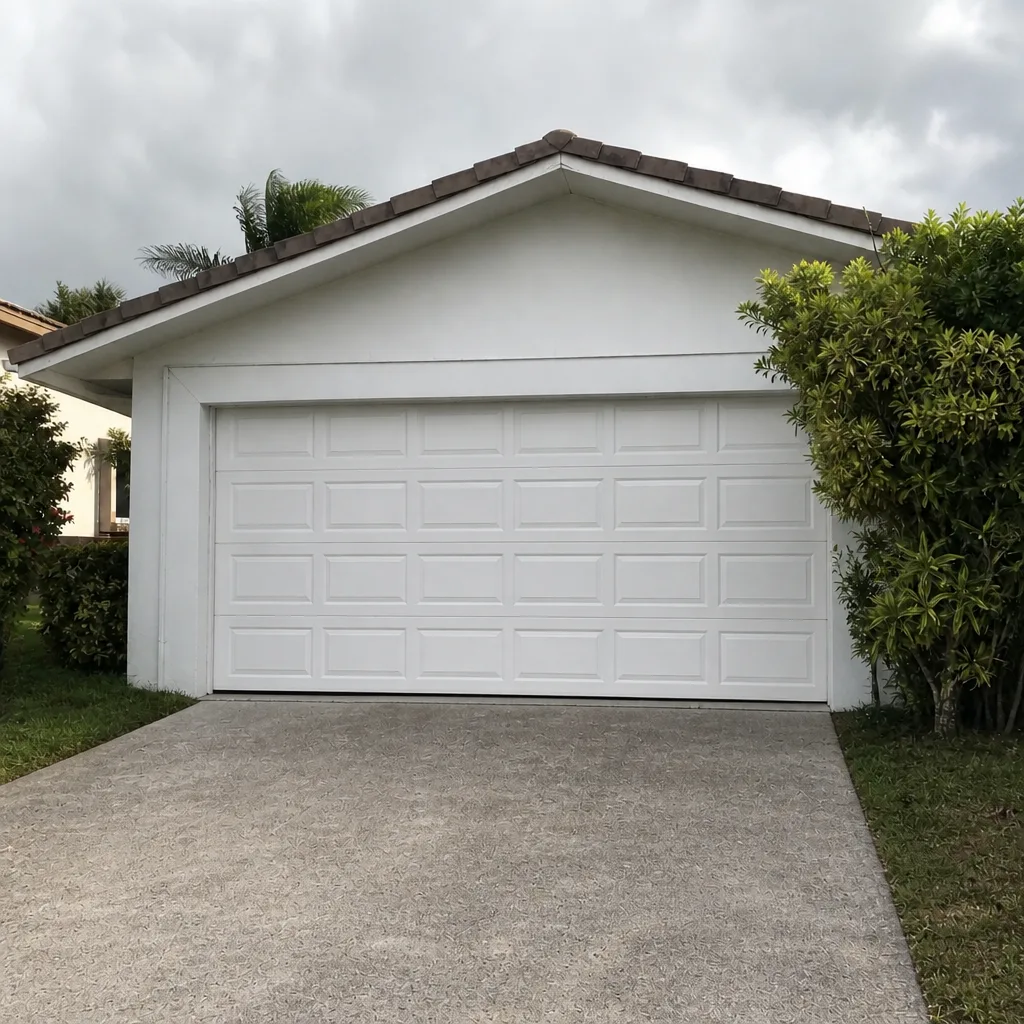 After
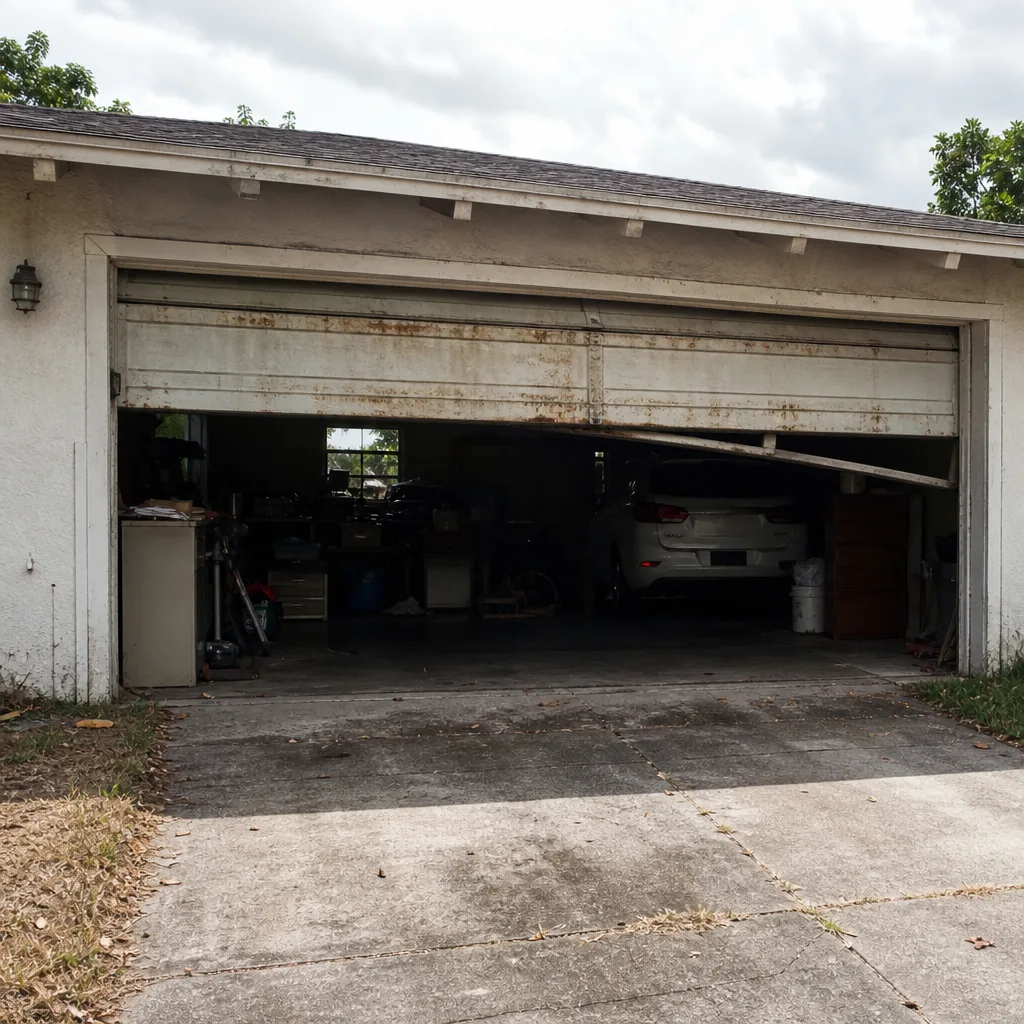 Before
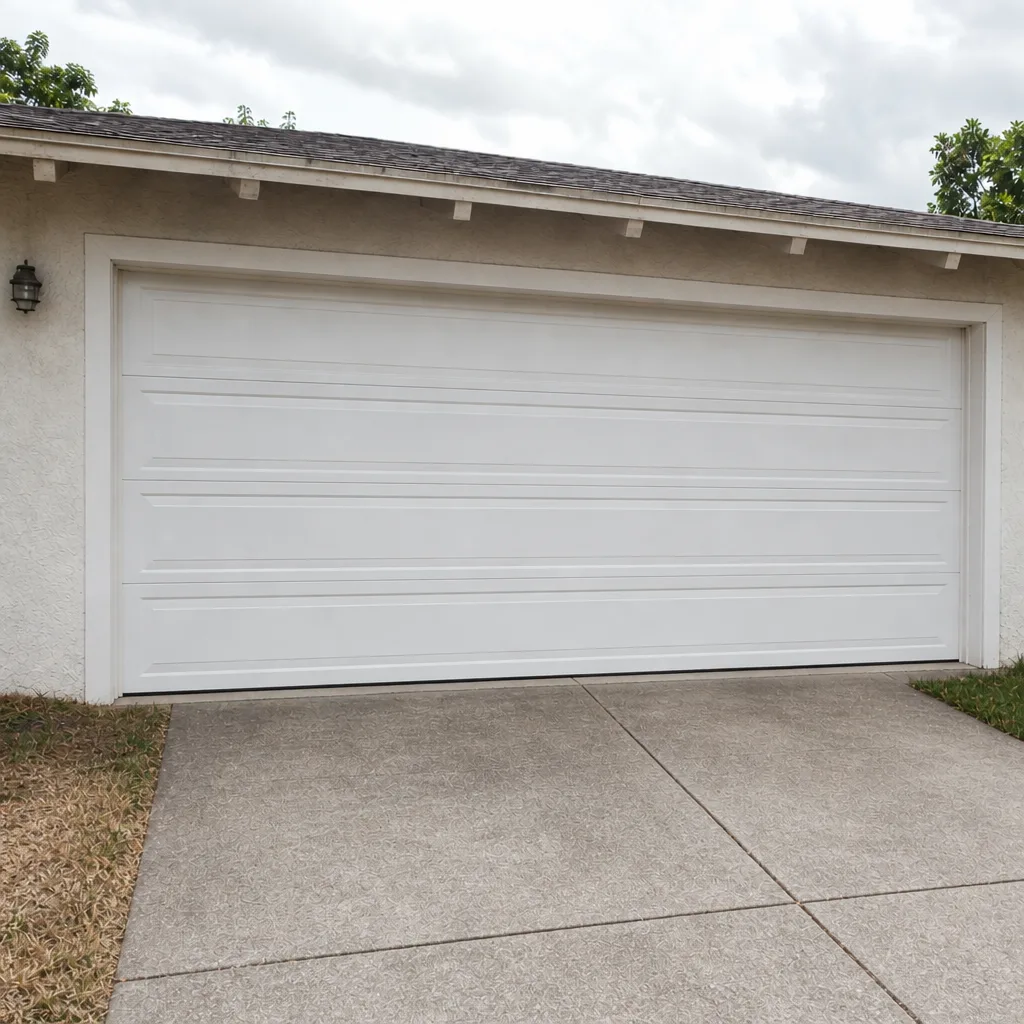 After
When to Call a Professional
Any of these scenarios is a call-to-a-professional moment. A door that won’t open or close; a loud snap, pop, or crash from the spring area; a door that feels heavier than it did a year ago; visible rust at the anchor plate or bolts; a safety reverse test that fails; a door stuck halfway with the opener still engaged; or storm damage that has bent the track or panel. Each of these is either dangerous to touch or a sign of a problem that could grow.
Garage door repair in Plantation isn’t a job for general handymen, and that’s not a knock on generalists – it’s that the spring system alone requires specific training and hardware. Plantation Garage Door Repair Pros offers free estimates in Plantation. We work on every major door and opener brand you’re likely to have installed, and we diagnose what’s already there rather than pushing a replacement. Call (866) 937-8852 for a free estimate. Our technicians have up to 9 years of experience, and spring repair is one of our core specialties. If you’d like to see how we handle the broader service, take a look at garage door repair and garage door opener repair. If your door has reached the end of its service life, our garage door installation service handles the upgrade.
Frequently Asked Questions
Twice a year for lubrication, monthly for the safety reverse test, and once a year for a professional inspection – ideally before hurricane season. Plantation’s humidity and summer storms put more wear on doors than a mild, dry climate does, so the routine checks matter more here. Call (866) 937-8852 for a free estimate if you’d rather have a technician walk through the checklist once.
Lubricating hinges, rollers, and tracks with silicone or white lithium grease is safe. Lubricating the torsion spring itself is safe as long as you look at it from the floor and don’t reach through or adjust anything. Any need to touch the spring, cable winding, or anchor plate is a call-a-professional task, not a DIY one.
Humidity driving corrosion at the anchor plate and spring coil is a major factor. High temperatures through the summer can soften lubricants that don’t resist heat, which lets grit into the coil. In our experience, the anchor plate rusting behind the wall is often the first sign something is failing – and that’s a wall check, not a door check. Call (866) 937-8852 for a free estimate; spring inspection is one of our specialties.
If the opener’s board responds to a button or remote inconsistently, or if surge damage is suspected, a technician can often repair the opener rather than replace it. Openers from LiftMaster, Chamberlain, Genie, Craftsman, and similar brands are engineered for repair. Replacement becomes the right answer when the motor itself is failing or the unit can’t be brought up to current safety standards. Get a free estimate first.
You can and should check it yourself. The flashlight test, paper test, and hand check take about five minutes. What to call for is the replacement: a poorly seated bottom seal lets in water and pests, and a retainer that’s pulling away needs hardware work. If your seal is worn or the door doesn’t sit flush, call (866) 937-8852 for a free estimate.
Yes, a dedicated surge protector between the opener and its outlet is one of the highest-value maintenance items in this climate. It protects the circuit board from lightning-induced voltage spikes, which are a leading cause of premature opener failure in South Florida. For connected openers running MyQ, Aladdin, or similar smart-home systems, the protection protects the electronics and the Wi-Fi chipset both. Call (866) 937-8852 if you’d like a professional opinion on the right setup for your opener.
The Bottom Line
Garage door maintenance in Plantation isn’t the same task as it is in a four-season climate. The threats are humidity, corrosion at the anchor plate, oversized Florida thresholds that let water in around the bottom seal, surge events from summer storms, and hurricane-season wind cycles that loosen hardware over time. Run the safety reverse and balance tests monthly, lubricate twice a year with the right products, check the bottom seal and anchor plate with a flashlight rather than a glance, and put a surge protector on the opener. Those four habits catch most failures before they become emergencies. When something doesn’t look right, Plantation Garage Door Repair Pros is here – free estimates, brand-agnostic diagnosis, spring specialists on staff. Our technicians have up to 9 years of experience. Call (866) 937-8852 for a free estimate. Or return to Plantation Garage Door Repair Pros for the full service overview.
Written by the team at Plantation Garage Door Repair Pros.